

Modular Construction Market Size, Innovation, Demand, Insights
Construction is becoming a manufacturing business. As capital, capacity and supply chains move offsite, a new set of winners is beginning to emerge.
Wilmington, DE, United States, Sept. 08, 2026 (GLOBE NEWSWIRE) -- Modular Construction Reshaping How Buildings Get Built and Who Controls the Market
Modular Construction Market has crossed a threshold that most industry observers have been slow to recognize. What began as a cost-reduction tactic for low-complexity residential projects has matured into a preferred delivery model for hospitals, hotels, and large-scale institutional facilities where schedule certainty and labor predictability now matter more than any other procurement variable. The structural shift is not incremental; it is directional, and the organizations treating it as a tactical option are already behind those treating it as a strategic platform.
What appears externally as a niche subset of the construction industry is, in practice, a market in which project economics are being rewritten. Factory-controlled production cycles are compressing delivery timelines that field-built programs cannot match. Supply chain integration is becoming a competitive differentiator rather than a logistics function. Developers, contractors, and institutional owners who locked in manufacturing relationships early are now quoting lead times and cost certainty that their competitors cannot replicate, and the gap between those two postures widens with each project cycle.
Request a Free Sample Report: https://marketmindsadvisory.com/request-sample/?report_id=36
Key Takeaways from Modular Construction Market
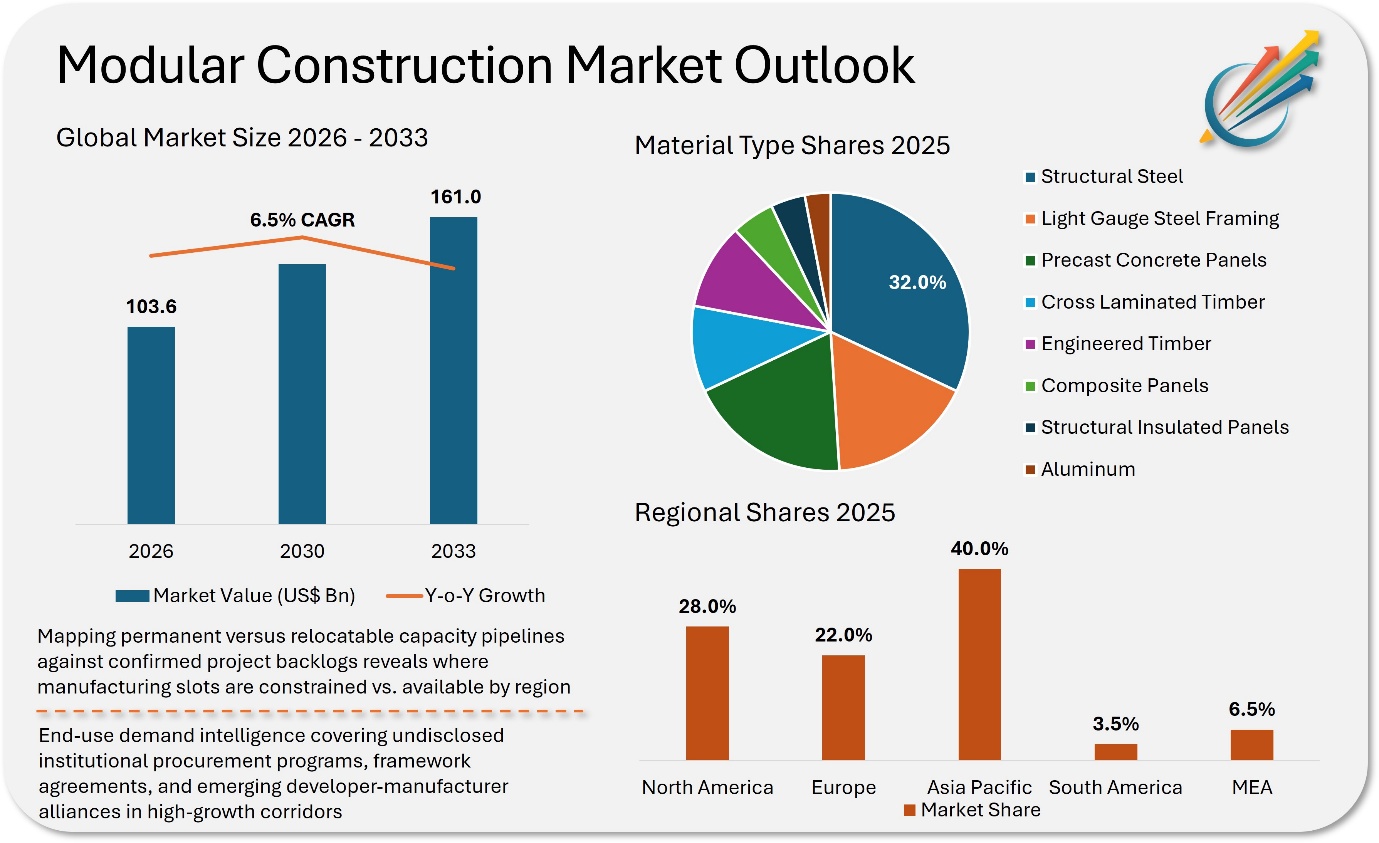
- Global modular construction market valued at US$ 103.6 billion in 2026, reaching US$ 161.0 billion by 2033 and expanding at 6.5% CAGR from 2026 through 2033
- Permanent volumetric construction leads segment mix, driven by healthcare and hospitality demand
- Labor shortages in traditional construction are accelerating offsite manufacturing adoption across all end-use categories
- Cross laminated timber and engineered wood gaining ground against steel in low-carbon project mandates
- Relocatable modular demand rising in mining, defense, and disaster-recovery deployments globally
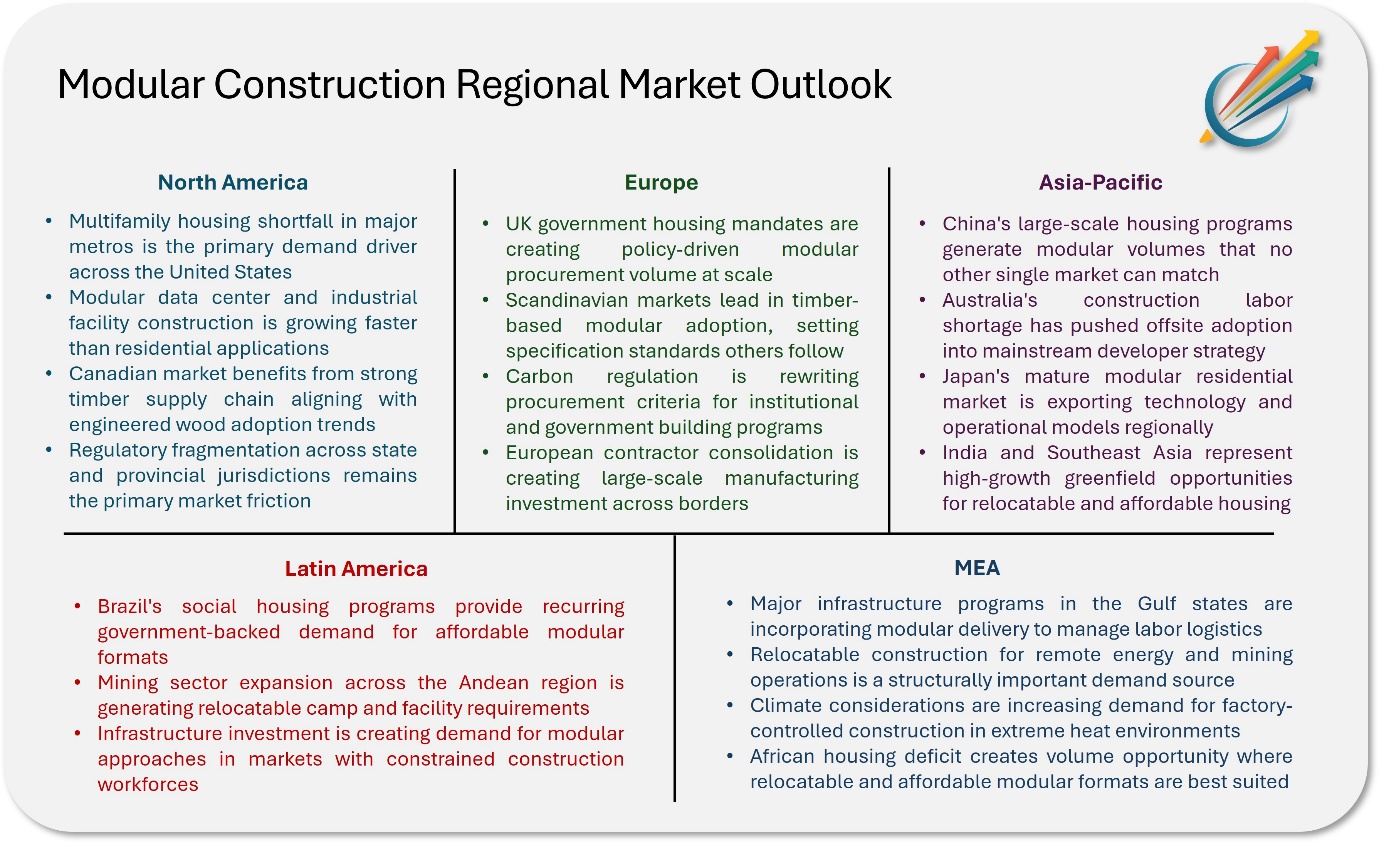
- Asia-Pacific pipeline of infrastructure and housing investment is creating the largest single regional volume opportunity
According to Lead Analyst from Market Minds Advisory, "The modular construction market is no longer competing with traditional building methods on price alone; it is winning on schedule certainty, labor efficiency, and quality control simultaneously. Organizations that secure manufacturing capacity and supply chain partnerships in the next 3-4 years to establish structural cost advantages that late movers will find very difficult to close."
The Window for First-Mover Advantage in Modular Is Measurably Narrowing
Manufacturing relationships that took early movers years to establish are now driving procurement decisions on major institutional and residential programs. The market is not waiting for late entrants to catch up.
- Factory capacity is the binding constraint: Modular manufacturers with proven production throughput are operating at high utilization. New entrants face lead times of 18 to 36 months before meaningful production scale is achievable.
- Design-for-manufacture expertise is compounding: Developers who have completed multiple modular programs carry embedded learning that directly reduces per-unit cost. This advantage compounds across successive projects in ways that one-off procurement cannot replicate.
-
Regulatory approval timelines favour incumbents: Modular construction systems require building authority approval processes that established players have already navigated. Newcomers absorb significant time and cost before first delivery.
Offsite Manufacturing Becoming the Default, Not the Exception
The construction industry's labor productivity problem has reached a point where offsite manufacturing is no longer a premium option; it is the structurally rational response to a workforce constraint that is not resolving. The shift is being accelerated by institutional clients who have absorbed enough field-construction delays to prioritize schedule performance over lowest-bid procurement.
- Healthcare and hospitality are leading the demand pivot: Both sectors place exceptional value on controlled-environment production quality and defined handover dates. Modular delivery now meets hospital infection-control requirements and hotel brand standards that field construction frequently fails to achieve consistently.
- Residential housing shortfalls are creating policy-driven volume: Government housing programs in multiple regions are explicitly specifying or incentivizing modular delivery to address chronic undersupply. This policy tailwind is creating demand that private market signals alone would not generate.
-
Multi-story volumetric systems are crossing viability thresholds: Engineering advances in structural steel and cross laminated timber are enabling modular solutions for buildings above six stories, opening commercial segments that were previously inaccessible to offsite methods.
Strategic Outlook Market Realities that Diverge from Consensus Expectations
The cost parity argument understates the actual value proposition. Most market commentary focuses on whether modular can match traditional construction costs. The more decisive competitive dimension is time-to-revenue, and on that metric modular outperforms field construction by margins that more than offset any remaining unit-cost premium. Investors and developers anchoring on cost parity are benchmarking the wrong variable.
Material substitution toward timber will accelerate faster than steel-centric supply chains currently anticipate. Cross laminated timber and engineered wood products offer carbon credentials that are becoming procurement requirements, not preferences, in European and Australian institutional markets. Steel-based modular manufacturers who do not develop timber capabilities will find themselves excluded from a growing share of high-value tenders.
The relocatable segment is significantly underrepresented in market forecasting. Mining sector expansion, defense infrastructure deployments, and climate-driven disaster recovery programs are generating relocatable modular demand that does not follow traditional real estate market cycles. This segment provides demand resilience through economic downturns that permanent construction cannot offer.
Structural Forces Reshaping the Modular Construction Value Chain
Labor Economics are Making Offsite the Default
Construction labor costs in developed markets have risen consistently for over a decade, and workforce availability in traditional trades is declining as older workers exit without adequate replacement. Factory production environments allow modular manufacturers to employ semi-skilled workers under more controlled conditions, achieving labor productivity levels that site-based construction cannot match. The differential is not marginal; in high-wage markets, labor cost savings from factory production are now frequently the primary driver of total project economics, displacing material cost as the dominant variable.
Material Science is Expanding the Addressable Market
The engineering properties of cross laminated timber, structural insulated panels, and composite materials have improved to the point where modular systems can address building typologies that were previously exclusive to conventional concrete and steel frame construction. Multi-story residential, mid-rise commercial, and long-span industrial applications are now technically viable in offsite formats. Each typology that crosses the viability threshold adds a new segment of developers, owners, and institutional clients to the addressable market, expanding the competitive space for manufacturers with diversified material capabilities.
Sustainability Mandates are Redefining Procurement Criteria
Green building certification requirements and embodied carbon targets are reshaping procurement decisions at institutional clients, major developers, and government agencies in ways that structurally advantage certain modular approaches. Engineered timber systems, in particular, offer lifecycle carbon profiles that concrete and steel alternatives cannot match. As net-zero building commitments move from voluntary to regulatory, procurement teams are increasingly required to evaluate embodied carbon at the shortlisting stage, creating a material advantage for manufacturers who have invested in low-carbon production systems and can provide credible environmental product declarations.
Digital Integration is Creating New Competitive Barriers
Building information modeling, digital twin integration, and design-for-manufacture software platforms are creating performance gaps between manufacturers who have invested in end-to-end digital workflows and those who have not. Contractors and developers who have integrated digital design with manufacturing execution report fewer site coordination errors, higher tolerance consistency, and faster approval cycles. These gains compound across repeat programs, creating a capability barrier that is measurably harder to close than a price or capacity gap.
Risk Assessment Material Headwinds That Could Moderate Deployment Pace
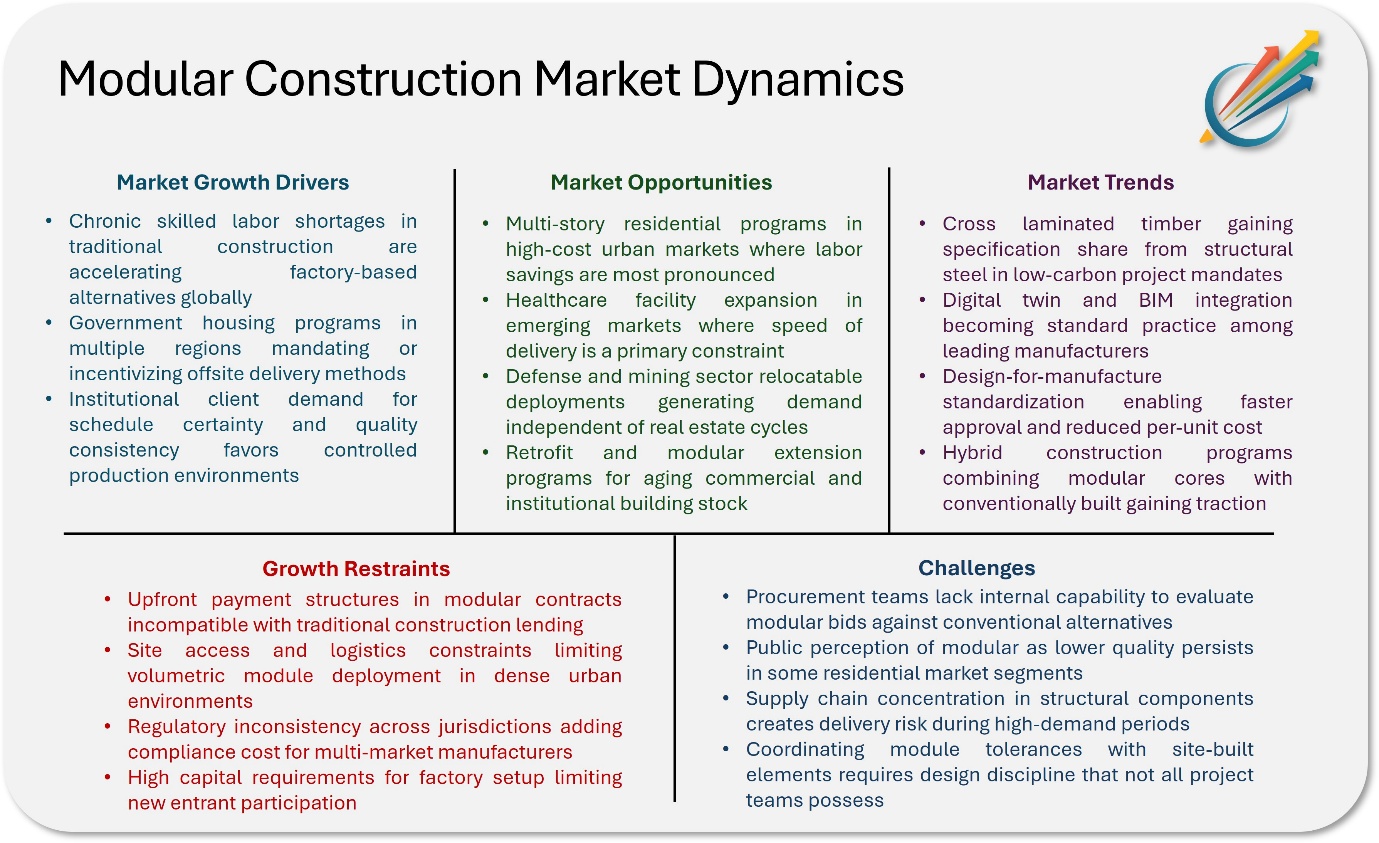
- Financing complexity: Modular projects present upfront payment structures that differ from traditional construction draws, creating friction with lenders whose credit models are calibrated to conventional delivery.
- Site logistics constraints: Large volumetric modules require crane access, road width clearances, and staging areas that urban infill sites frequently cannot accommodate without cost penalties.
- Regulatory fragmentation: Building codes and approval pathways for offsite construction vary significantly across jurisdictions, adding compliance cost and schedule risk for manufacturers operating across multiple markets.
- Perception gaps among procurement teams: Many institutional procurement teams lack internal expertise to evaluate modular bids equitably against traditional construction, creating evaluation friction that delays adoption.
- Supply chain concentration risk: The modular supply chain for structural components remains concentrated among a limited number of manufacturers, creating vulnerability to disruption in specialist inputs.
- Technology investment timing: Manufacturers who invest early in digital and material capabilities face margin pressure before volume justifies the investment, creating a period of financial exposure during scale-up.
None of these constraints are structural barriers to long-term adoption. Each represents a friction point that the market is actively solving, and the directional conclusion remains that modular's share of total construction output will increase through the forecast period.
Market Dynamics Shaping the Modular Construction Market
Modular Construction Market Segmentation
By Construction Type
- Permanent
- Volumetric (3D) Construction
- Panelised (2D) Construction
- Relocatable
- Volumetric (3D) Construction
- Panelised (2D) Construction
Permanent construction represents the dominant volume, with volumetric systems commanding the highest value per unit due to the degree of factory completion they deliver. Panelised systems occupy a mid-ground, offering faster site erection than conventional build while retaining flexibility that full volumetric systems sacrifice. Relocatable construction is often underestimated in market analyses; mining, defense, and humanitarian deployments generate recurring demand with strong margin profiles. The relocatable segment's independence from real estate market cycles provides manufacturers with a demand buffer that pure permanent-focused players do not have access to.
By Material Type
- Structural Steel
- Light Gauge Steel Framing
- Precast Concrete Panels
- Cross Laminated Timber
- Engineered Timber
- Composite Panels
- Structural Insulated Panels
- Aluminum
Structural steel and light gauge steel framing collectively represent the largest material share of the current market, reflecting their established engineering credentials and supply chain depth. Precast concrete panels remain relevant for large-scale repetitive applications. The more strategically significant trend is the rapid adoption of cross laminated timber and engineered timber, driven by embodied carbon requirements that are tightening across European and Australasian institutional markets. Composite panels and structural insulated panels serve niche performance applications where thermal, acoustic, and structural properties must be achieved simultaneously without weight penalties.
By Module
- Four-sided
- Open-sided
- Partially Open-sided
- Mixed Modules & Floor Cassettes
- Others
Four-sided modules provide the highest degree of factory completion and are the format of choice for hospitality, student accommodation, and healthcare applications where room-based layouts align naturally with volumetric module geometry. Open-sided modules trade completion level for span flexibility, serving applications where large open floor plates are required. Mixed modules and floor cassettes represent a growing hybrid approach, allowing structural and service elements to be factory-completed while retaining flexibility for fit-out customization that end users increasingly require.
By End Use
- Residential Housing
- Commercial Buildings
- Hospitality
- Healthcare Facilities
- Industrial and Manufacturing Facilities
- Institutional Building
- Others
Residential housing commands the largest volume share, underpinned by housing shortfall programs and build-to-rent demand in major markets. Healthcare and hospitality represent the highest-value segments on a per-project basis, driven by the premium these sectors place on factory-controlled quality and delivery schedule. Industrial and manufacturing facility construction is an underappreciated growth segment; the expansion of logistics, data center, and advanced manufacturing capacity is generating modular demand with specification requirements that commodity residential production cannot serve, creating margin opportunity for manufacturers with industrial build capability.
Shape this report around your question: https://marketmindsadvisory.com/request-customization/?report_id=36
Regional Market Outlook
Investment Focus where the Highest-Value Opportunity is Concentrating
Healthcare and Hospitality Present the Strongest Margin Profile
Both sectors operate under procurement mandates that prioritize quality consistency and delivery certainty over lowest-bid pricing. Healthcare facilities require infection-control environments and phased delivery that factory production handles more reliably than site construction. Hospitality brands enforce room-finish standards that volumetric modules achieve consistently. Manufacturers with proven delivery records in these verticals are commanding price premiums and repeat program allocations that commodity modular producers cannot access.
Multi-Story Timber Systems are the Fastest-Growing Structural Frontier
Cross laminated timber and mass timber systems are enabling modular solutions above six stories in markets where carbon regulation and embodied carbon targets have become mainstream procurement requirements. The intersection of engineering capability, supply chain investment, and sustainability credentials is where the most defensible competitive positions are forming. Manufacturers who establish timber-based multi-story credentials in the next two to three years will occupy structurally advantaged positions as regulatory requirements tighten.
Relocatable Segment Offers Counter-Cyclical Demand Resilience
Mining, defense, and humanitarian deployments generate demand patterns that do not correlate with real estate market cycles, providing manufacturers with revenue stability through economic downturns. The margins in custom relocatable programs are structurally higher than commodity residential production. Investment in relocatable capability is not just a demand opportunity; it is a portfolio hedge for manufacturers whose core business is exposed to housing market cycles.
Digital Workflow Integration is Creating Durable Competitive Differentiation
Manufacturers who have invested in end-to-end digital workflows connecting design, manufacturing execution, logistics, and site installation are achieving performance levels that late adopters cannot quickly replicate. The compounding advantages of digital integration accumulate across projects, widening the performance gap with each program delivered. Treating digital capability as a strategic asset rather than a procurement step is the posture that is consistently separating first-tier manufacturers from the broader market.
What This Means for Decision-Makers
Real estate developers - The competitive advantage in residential and commercial development is shifting toward those who have established repeatable modular delivery programs. Developers without manufacturing relationships are increasingly competing at a cost and schedule disadvantage on projects where institutional peers have already locked in factory capacity.
Construction contractors - Contractors who have built offsite manufacturing capability or established deep supply chain relationships with modular manufacturers are structurally positioned to bid programs that field-only peers cannot. The window for building this capability organically is narrowing as manufacturing capacity is absorbed by long-term program commitments.
Investors - The modular construction investment thesis has matured past early-stage technology risk. Manufacturers with proven multi-story or specialist healthcare and hospitality delivery records represent attractive platforms where operational leverage, repeat program revenue, and digital capability create compounding value over the forecast period.
Institutional procurement teams - Organizations that have not yet developed internal capability to evaluate modular delivery on equal terms with traditional construction are absorbing unnecessary risk in their project programs. Building procurement expertise in modular specification, contract structuring, and manufacturing audit is now a material risk management priority, not a future capability investment.
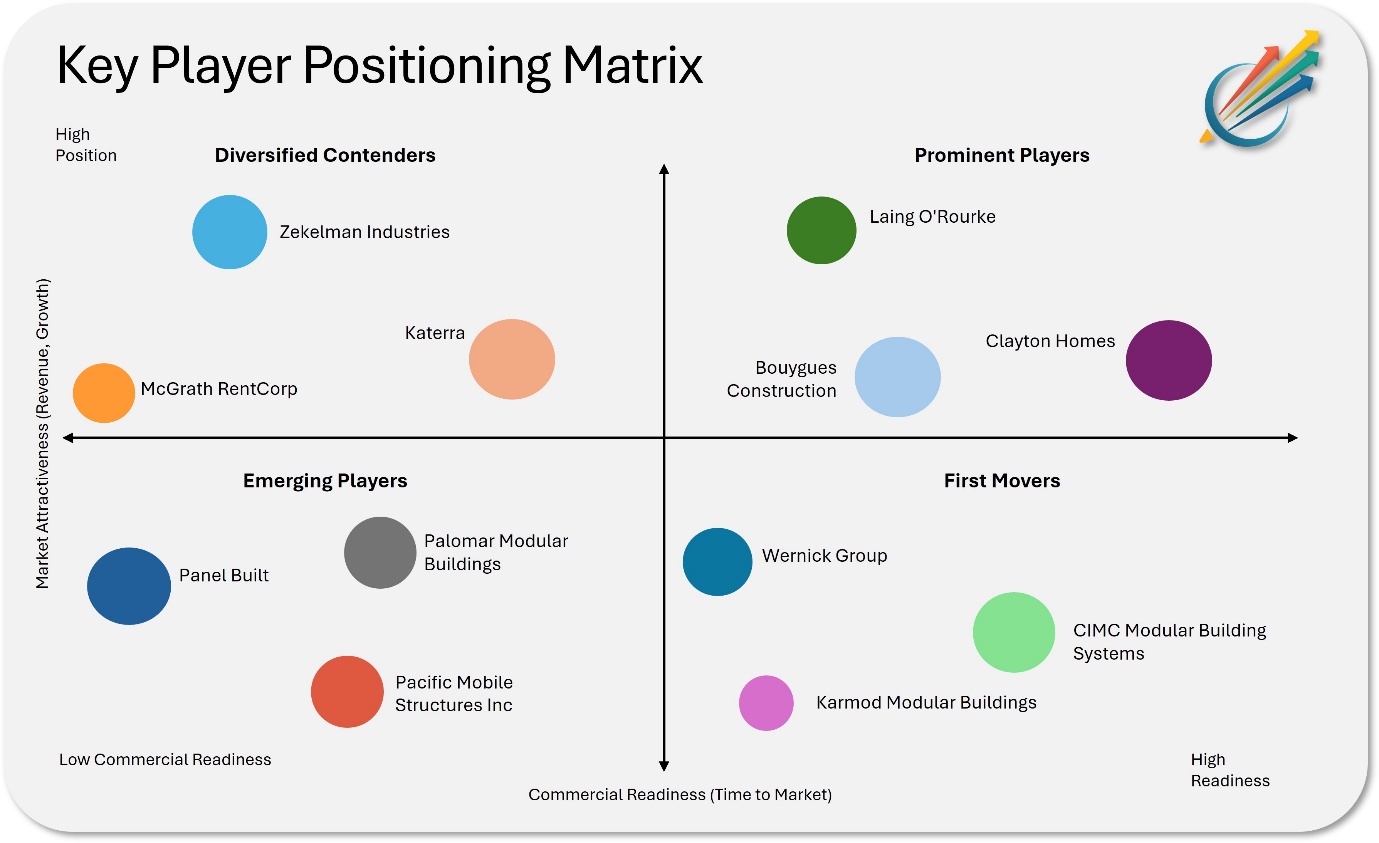
Competitive Landscape – Modular Construction Market
Recent Market Developments
- In December 2024, Laing O'Rourke announced an expansion of its volumetric manufacturing facility in the United Kingdom to increase annual production capacity in response to growing healthcare and residential program demand
- In January 2025, Lendlease Corporation confirmed the completion of a major modular residential tower in Sydney, establishing a new benchmark for multi-story volumetric construction in the Australian market
- In February 2025, Modulaire Group expanded its relocatable fleet operations across Northern Europe to address infrastructure and industrial project demand in Scandinavian and Baltic markets
- In March 2025, CIMC Modular Building Systems secured a series of export contracts supplying volumetric hotel modules to Middle Eastern hospitality projects as Gulf infrastructure programs accelerated procurement.
Get Access to complete Analysis, Buy Now: https://marketmindsadvisory.com/buy-now/?report_id=36
Market is segmented by Construction Type (Permanent, Relocatable), Material Type (Structural Steel, Light Gauge Steel, Precast Concrete, Cross Laminated Timber, Composite Panels), Module (Four-sided, Open-sided, Partially Open-sided, Mixed Modules & Floor Cassettes), and End Use (Residential, Commercial, Hospitality, Healthcare, Industrial, Institutional)
Trending Reports
- Smart Water Grid Market: Water utilities aren’t buying smart grids, they’re buying accountability. As water loss becomes regulated, the biggest opportunity is shifting from meters to intelligence.
- Session Border Controller Market: SBCs are quietly becoming the security layer for enterprise communications reshaping who controls voice traffic, cloud connectivity and the next generation of business communications.
- Pre Insulated Pipes Market: The next energy-efficiency battle may be buried underground where insulation performance, installation economics and network design are quietly reshaping infrastructure returns.
- Positive Displacement Pumps Market: A quieter shift is reshaping the pump industry: buyers are moving beyond flow and pressure to judge pumps by the economics of every hour they operate.
- Palletizing Robots Market: The next palletizing battle won’t be fought over robot speed. It will be decided by who can automate complexity, mixed loads and production changeovers profitably.
- Modular Robotics Market: The robotics race is shifting from speed and precision to reconfiguration. The winners will be those who can turn one automation asset into many production capabilities.
- Mobile Substations Market: The power bottleneck is moving faster than the grid. Mobile substations are emerging as a strategic bridge between rising electricity demand and infrastructure that takes years to build.
- Industrial Robotic Motors Market: The robot is only as capable as the motor driving it. A quiet shift in motion technology is now reshaping who can win the global automation race.
- Industrial Security System Market: The security perimeter is disappearing. As industrial assets become connected, the winners will be those protecting not just facilities, but the operations running through them.
- Industrial Nailers Market: The humble nailer is becoming a productivity weapon where cordless platforms, automation and faster fastening are quietly rewriting the economics of construction and manufacturing.
Why choose Market Minds Advisory
Market Minds Advisory delivers decision-grade intelligence to executives across machinery, packaging, chemicals, automotive, ICT, food and beverage, consumer goods, and healthcare. We help organizations sharpen market expansion strategies, accelerate share gains, refine brand positioning, and enable account-level growth. Our forecasting integrates primary interviews, proprietary demand models, and continuous market validation, producing the kind of clarity volatile and emerging industries require. Backed by over a decade of sector expertise, our research surfaces white space, opportunity gaps, and competitive blind spots, accounting for recent developments and geopolitical risk. We help businesses see the future of their markets.
Contact Us
Market Minds Advisory
1521 Concord Pike, Suite 301
Wilmington, DE 19803
United States
Email: sales@marketmindsadvisory.com
Website: https://marketmindsadvisory.com/


Legal Disclaimer:
EIN Presswire provides this news content "as is" without warranty of any kind. We do not accept any responsibility or liability for the accuracy, content, images, videos, licenses, completeness, legality, or reliability of the information contained in this article. If you have any complaints or copyright issues related to this article, kindly contact the author above.
